Saturday, May 17, 2008

Quote of the 21st century

I just can't believe what I am reading these days, from the New York Times here is a quote of the 21st century: (Bush using alternative energy as a threat!)
The image “http://tbn0.google.com/images?q=tbn:-2FxhBm9i0AZGM:https://blogger.googleusercontent.com/img/b/R29vZ2xl/AVvXsEhJzzW3-RsX-m0qWePhy_CTOT0uYJORrcktW3E3oixFzM145p062QOezdLRuJFi1ZZ7dEzqA5U74fMmW3VhYXlF2TwfvtTKSWO-n-WlM2uOEbFbj2iuRkuE4nkcrS2Zu5d2AQF8lyljmms/s400/argue.jpg” cannot be displayed, because it contains errors.
“I said very plainly, I said, ‘You’ve got to be concerned about the effects of high oil prices on some of the biggest customers in the world,” Mr. Bush said. “And not only that, of course, high energy prices is going to cause countries like mine to accelerate our move toward alternative energy.”

I couldn't have made this stuff up in a fictional novel.

Here we now have Bush using alternative energy as a 'threat' towards the Saudis'.

From my last blog of April, where I said:
intuitiveblogger: "If we could hear Bush talk at least once about sustainability, this would be the first wave of a magic wand..."

Well I guess this last Bush quote is a magic wand although in this case it is looking more like a wand in the form of a double edged sward . Bush is now threatening to go alternative because the Saudis won't give more oil to bring down the prices. What next?

I think we have officially reached the age of peak oil.

Watch out for many changes over the next few months.....

intuitiveblogger

Wednesday, April 30, 2008

Bush's April 2008 quotes

Has Bush been reading intuitiveblogger?

Bush's popularity lowest in U.S. history, poll shows

Here are some Bush quotes from April 2008 echoing
a post from
intuitiveblogger: 2008_03_01_archive.htm


BUSH April 2008:

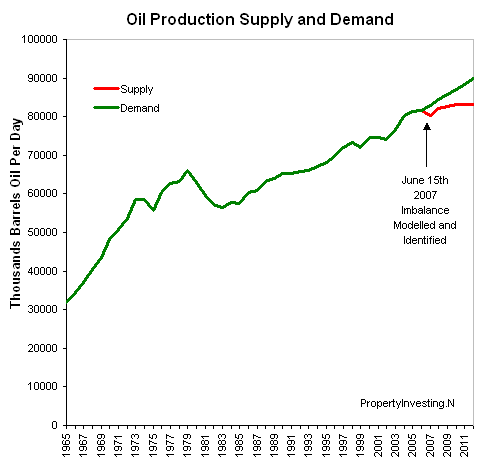
"One of the main reasons for high gas
prices is that global oil production is
not keeping up with growing demand"


IntuitiveBlogger explains the JUNE 15th point of no return here: 2008_03_01_archive.htm


BUSH QUOTE April 2008:

"I think we better understand that
there's not a lot of excess capacity
in this world right now"

IntuitiveBlogger: 2008_03_01_archive.html


BUSH QUOTE April 2008:

"Demand is rising faster than supply.
And that's why you're seeing global
energy prices rise"

He is repeating himself:

(but yes, this does match the Supply An Demand chart)

The image “http://www.directopedia.org/onTEAM/wiki/img/9/320px-Simple_supply_and_demand.png” cannot be displayed, because it contains errors.
BUSH QUOTE April 2008:

"But there is no magic wand to
wave right now. It took us a
while to get to this fix."


If we could hear Bush talk at least once about sustainability, this would be the first wave of a magic wand... Instead, we have to learn about sustainability from a power point presentation by Richard Heinberg and I really recommend you watch it!

Sustainability is not magic as it does not produce energy, but it is an essential step in the right direction.
Green energy is not magic as it takes energy to build green solutions, but it is a way to get us off non renewable energy sources. It is an essential step in the right direction and there is no time to waste, we should have started years ago.

There is no easy fix to an energy crisis with over six billion people on this planet relying on
-and I mean relying on-
fossil fuels to live. Blaming one person like Bush is not the answer.
Although the institution he represents appears to have gone nuts to me. Eight years
has gone by and this superpower has preemptively invaded a middle eastern country
with a lot of oil - Iraq, for what seems to ultimately have been to secure more oil, a non-
renewable energy source becoming scarce and too expensive to float the economy.
Today, in April 2008, we hear more of the same headlines... "More oil drilling a must" Bush says.

Very disappointing....


Tuesday, April 29, 2008

Five contributions towards a world food crisis:

http://www.alternet.org/blogs/peek/83387/


Five causes of the food crisis:

  • A Biodiesel increase is taking away food from people's mouths
http://www.freewebs.com/renata17/biodiesel_pump_with_flowers.jpg
http://climateprogress.org/wp-content/uploads/2007/09/australia-drought.jpg
  • More people have adapted to eating meet around the world, which demands a lot more grain.
The image “http://www.abc.net.au/reslib/200706/r151097_538101.jpg” cannot be displayed, because it contains errors.The image “http://www.ens-newswire.com/ens/feb2006/20060227_chickens.jpg” cannot be displayed, because it contains errors.
  • Rising gas prices have made transportation of food costs increase (most people don't eat local)
The image “http://libcom.org/files/imagecache/article/files/super-tesco%5B1%5D.JPG” cannot be displayed, because it contains errors.
  • Rising gas prices have made petroleum based fertilizers more expensive (Most people don't eat organic food).
http://www.filterclean.co.uk/images/infospecialistimages/infonitrateimage.jpg


Democracy Now!

http://www.democracynow.org/2008/4/8/stuffed_and_starved_as_food_riots

RAJ PATEL: Well, it’s a number of factors. For a start, there were just bad harvests last year. Some people say that this is a sign that climate change is biting in agricultural economies. And it’s certainly the case that there was some very bad weather, particularly in Australia, last year. So there’s a low level of crops available.

But on top of that, there are a few other factors. One of them, one of the issues, is that governments, particularly the US government, is very keen on biofuels. Biofuels are fuels that are derived from corn, from sugar cane, and they’re being presented as a way of achieving energy independence. The trouble is, of course, that the biofuels drive up the price of these commodities, which means that poor people can’t afford them anymore.

On top of that, you’ve got an increasing demand for meat in developing countries. And as people get richer in those countries and they shift to something that looks more like an American diet, you have a situation where the grains are being diverted away from poor people and into livestock. So, again, that’s driving up the price of grains.

And finally, I think one of the major issues is, of course, the price of oil. I mean, one of the problems with the way our food reaches us today is that it is industrial, it is very fossil fuel-intensive, not just to the distance the food travels, but also in the fertilizer. You know, fossil fuel is required to produce fertilizer, pesticide, these sorts of things. And so, when the price of oil is over $100 a barrel, that combines with all the other factors to make a perfect storm where food prices are absolutely beyond the means of the poorest people.

Was the year 2005 a peak year?

Let's go back to the GOLDEN YEAR of 2005 ?

Price of oil is around $40- $60

The image “http://tbn0.google.com/images?q=tbn:kJz6fxdky4a3AM:http://www.electricscotland.com/thomson/images/20.28%2520oil_barrel2.jpg” cannot be displayed, because it contains errors.
http://upload.wikimedia.org/wikipedia/en/thumb/2/2f/Oil_Prices_Medium_Term.png/800px-Oil_Prices_Medium_Term.png

In 2005, it seems the number of domestic European flights (ryanair.com) while fuel costs were still low increased dramatically!
The image “http://upload.wikimedia.org/wikipedia/en/3/3d/Ryanair_passengers.jpg” cannot be displayed, because it contains errors.

....This was probably helped by the fact Ryan air regularly gave away millions of (excluding airport taxes) free plane tickets.

http://www.johnnyjet.com/images/PicForNewsletterIreland2005RyanAirSnapShot.JPG

Tickets today in 2008 are around $10 - $20 (from England to the South of Spain) which is over 10 times the cost from 2005, but still less than the cost of a cab (for me) from Burbank to Hollywood.

I wonder how long this
$10 - $20 ticket price will last?
From London (Stansted)
FreeBelfast (City) £10
Aarhus £10Dublin £10
Frankfurt (Hahn) £10
Glasgow (Prestwick) £10
Knock £10Newquay £10
Oslo (Torp) £10
Shannon £10Turin

Maybe for a while longer as I see Ryanair have started by being sneaky....with bags and check-in prices increasing. This will not interfere with their aggressive 'cheap ticket' campaign and with less bags checked in (due to people taking less with them) this will actually save the airline fuel (which has suddenly become more expensive since 2005).

The image “http://image.guim.co.uk/static/50254/original/zones/business/images/logo.gif” cannot be displayed, because it contains errors.,
Ryanair hikes bag and check-in charges

Ryanair today raised the cost of putting bags in the hold and checking in at airports as the high cost of oil forced airlines to scrabble for extra revenues.


Ryanair


It is interesting to note, house prices in 2005 had been
skyrocketing like mad for five years!

http://www.pricedout.org.uk/html/images/Nationwide_RealHousePrices.png

Those were good times...

But what are we doing now? Are we trying to fix a situation, so we can go straight back to what we were doing in 2005? My intuition says there was no golden year of 2005... I see the boom was not real and we are simply paying back for the credit madness now. What we had was: “a demonstrably fragile financial system that has produced unimaginable wealth for some, while repeatedly risking a cascading breakdown of the system as a whole”. These words from a guy named Paul Volcker, who was the former Federal Reserve chairman.
http://www.nytimes.com/2008/04/11/business/11norris.html
As the credit crisis has slowly expanded and worsened, there has been a flurry of activity in Washington to reduce the damage from it. There are bailouts and tax breaks, and even checks to parents of school-age children. But there is remarkably little action aimed at getting the credit system functioning again. In part, that is because there is a scarcity of ideas. Paul Volcker, the former Federal Reserve chairman was right this week when he said the financial engineers had created "a demonstrably fragile financial system that has produced unimaginable wealth for some, while repeatedly risking a cascading breakdown of the system as a whole."
This guy calls it "The Bush Recession" and "We can fix it all..."
http://www.visitorfromtomorrow.com/?p=79&ref=patrick.net

This guy asks "How far is too far?" and "Is there anything the U.S. Federal Reserve won't do?"
http://www.moneyandmarkets.com/issues.aspx?Fed-White-House-and-Congress-bail-out-Wall-Street-1656


By the way, I think it was quite easy to predict a UK housing bubble going pop. Although different to the US bubble (there is still a demand for a primary place of residence) the growth of house prices have become unfordable. Once prices have climbed too high, the demand for living space is no longer enough (mortgages are out of people's reach) so to move inventory, prices have to come down to sustainable levels. Buyers will once again be looking for dwellings according to what they can afford.
http://www.telegraph.co.uk/money/main.jhtml?view=DETAILS&grid=&xml=/money/2008/04/08/bcnhsbc208.xml
UK housing bubble is bursting and it's serious

I leave you with another interesting blog to read about intuition!
http://www.intuition-blog.com/?cat=1
Intuition Blog :: Intelligence for the 21st Century

Saturday, April 12, 2008

Supertramp: 1970's Crisis? What Crisis?

http://991.com/newgallery//Supertramp-Crisis-What-Crisi-186390.jpg

Crisis? What Crisis?
Looks like there was intuition around in the 1970s...


This album was Supertramp's first album to be recorded in America in Los Angeles.
Living in LA myself, I can see where they got the idea for this cover. It would have been great if people had focused on using cleaner and renewable energy around this time, since it first became available over 20 years ago. I am sure if an energy initiative had started then, we would have more than 1% wind power being used in 2008. As mentioned in a previous blog, I would seriously recommend investing today in green renewable energy.

Wind can help solve energy crisis
http://www.environmental-expert.com/resultEachPressRelease.aspx?cid=19957&codi=30081&idproducttype=8&level=0

Since it became a viable energy resource around 20 years ago, wind power has emerged as a leading renewable technology. At the end of 2006 the worldwide capacity of all wind turbines was close to 75 gigawatts, which represents around one percent of all electricity use in the world. Three quarters of that wind power usage is currently based in Europe.
Although these days it seems there are more pressing issues about a food crisis... (relates to energy)
http://news.bbc.co.uk/2/hi/business/7345031.stm
BBC: Analysis: What to do about credit and food. Food and finance.
Those have been the two big themes over the last week at the IMF and the World Bank.

http://news.bbc.co.uk/2/hi/business/7344892.stm
The IMF's Strauss-Kahn says "the problem could lead to trade imbalances that may eventually affect developed nations, so it is not only a humanitarian question".
And a lot more to read about the global food crisis here:
http://intuitiveblogger-news.blogspot.com/2008/04/food-crisis-around-world-is-real.html

The World Food Crisis: A closer look at the food situation

I am a relatively new blogger who lives an interesting life working in Los Angeles. It took me a long time to get used to this way of living as I was raised in a small village in Britain. I have traveled and read a lot and have talked to many people with diverse backgrounds. I listen to opinions and do not easily draw conclusions. I believe we all re-assess our knowledge as we grow older. If I don't know the answer to something, research helps, but I also find intuition combined with the sub-consciousness thought process can help understand situations. It does not always take rocket science to figure out the answer to something when the answer is obvious.

I started writing this blog in July 2007 to try and figure out how we can keep living the way we do in an unsustainable fashion.

It seems there is a similarity between dept in money and dept in ecology. I had a strange dream a few months ago where people were consuming so much and so fast, there was not enough to go round. If we look closely at what is happening, this dream is not very far from reality.

Ears of wheat growing in a field

Looking at an article The World Food Crisis I found this week in the New York Times, I have decided to investigate how a potential world food crisis could affect someone like myself living in the entertainment capital of the world.


The World Food Crisis
http://www.nytimes.com/2008/04/10/opinion/10thu1.html?_r=1&oref=slogin

Americans take food for granted. Even the poorest fifth of households in the United States spend only 16 percent of their budget on food. In many other countries, it is less of a given. Nigerian families spend 73 percent of their budgets to eat, Vietnamese 65 percent, Indonesians half. They are in trouble.


I am going to start by looking at my own budget over the past six months to see if the New York Times statement was correct.


[b_oa.jpg]

I used a service called MyPortfolio with Bank of America to pull up this information. It is a great service as it is automatic. You will see I have spent 11.22% of my income on groceries and 4.37% on restaurants. So this is almost the 16% as stated in the New York Times.

So if food were to double in price, I would probably have to cut down something like as follows:

Entertainment(cut 50%+) =3% reclaimed
Clothes------(cut 50%+)
=4% reclaimed
Travel-------(cut 50% ) =4% reclaimed
Other costs--(cut 20% ) =5% reclaimed


If I can adjust my food spending budget to double, making it 32% of my salary, this is still going to be 41% less than the percentage of salary people are spending today in Nigeria.

I am certainly very lucky as I am sure there is excess in my other budget, but from now on I should be careful, or at least be aware of what is going on. Also, if I look at my automotive expenses, I cannot assume these will stay the same over time. If anything, automotive costs will increase over time and I am including the price of fuel. Remember this?

The image “http://msnbcmedia1.msn.com/j/msnbc/Components/ArtAndPhoto-Fronts/COVER/080411/g-cvr-080411-food-1030a.grid-4x2.jpg” cannot be displayed, because it contains errors.


To recap from my rather bold blog quote September based partly on a book Not On The Label
by Felicity Lawrence:

Intuitiveblogger: "
The price of food could reach critical levels including shortages in Britain and parts of the US by early as 2009"

... I know this statement sounds rather bold and I certainly hope a critical situation does not occur, but if the British Chamber Of Commerce starts to feel nervous with soring rice prices today, than the definition of critical may not be far off. I must add I was still surprised to see this news come in from the BBC:

The image “http://d.yimg.com/us.yimg.com/p/bbc/20080412/vidlthumb.c815e8531322009a25b4e980b984edbe.jpg” cannot be displayed, because it contains errors. UK rice price doubles
BBC - Fri Apr 11, 2:55 AM ET

The price of rice has soared as demand outstrips supply, putting pressure on UK Indian restaurants.

In this clip, I found it strange when the owner of the restaurant expressed to the BBC that he would rather take a £140 hit a week (a loss due to the more than double cost of rice) rather than pay to re-print menus, so customers can pick up the tab. Maybe it would be cheaper to reprint the menus except the risk of losing customers would be greater. I guess they are subconsciously deciding to not take action and foot the £7,280 ($14,000) yearly bill themselves for now, to avoid losing customers.

It is not just food and fuel prices going up. I was visiting a specialized whiskey shop this week and the owner told us the price of Whiskey had recently gone up dramatically. He said it was partly due to the recent exports demand growing from China.

_______________________________________________________________
Here are more articles out this week on the topic of food becoming expensive. I leave you with some articles as food for thought...
(On this note, I will try not to waste food)

Cost of food going up

http://www.msnbc.msn.com/id/24065922
ROME - Even with bigger crops, soaring food prices that have sparked unrest across the globe are likely to persist, threatening millions of people worldwide, a U.N. agency said Friday.


http://www.guardian.co.uk/business/2008/apr/10/worldbank.fooddrinks
World Bank: rocketing food prices have put fight against poverty back 7 years


http://www.nytimes.com/2008/04/09/business/09conserve.html?em&ex=1207972800&en=15639fefc3e3d631&ei=5087%0A
Out on the farm, the ducks and pheasants are losing ground.


http://www.plenglish.com/article.asp?ID=%7B2373E973-C3E5-43AD-A8F4-8C76EE20573E%7D)&language=EN
Food Crisis in Central America. San Salvador, Apr 9 (Prensa Latina) The rising costs of food is creating a crisis situation in Central America, which has 7.5 million undernourished people, informed the United Nations Food and Agriculture Organization.


http://www.number-10.gov.uk/output/Page15233.asp
Gordon Brown has called upon the G8 to press international institutions such as the United Nations to take action on a growing crisis in global food prices.


http://www.ens-newswire.com/ens/apr2008/2008-04-09-02.asp
DUBAI, United Arab Emirates, April 9, 2008 (ENS) - Warning that spiralling food prices are leading to increased poverty and unrest, several senior United Nations officials are calling for urgent measures to tackle the global crisis, which is causing the most suffering among the world's poor.

http://www.allheadlinenews.com/articles/7010589442
"Food price hikes are also linked to higher energy and fertilizer prices, a weak dollar and export bans," the note said.

"Poor people are suffering daily from the impact of high food prices, especially in urban areas and in low income countries," World Bank Group President Robert B. Zoellick said in a statement.


http://timesofindia.indiatimes.com/Food_crisis_in_2-3_months/articleshow/2939102.cms
NEW DELHI: The world had just about enough cereal stocks to feed the global population for two to three months. With a crisis looming worldwide, food prices too are far from coming down, the United Nations' Food and Agriculture Organisation revealed on Wednesday.


http://news.xinhuanet.com/english/2008-04/10/content_7951412.htm
Haitian president calls for calm, says violence will not halt food price rise


http://www.reuters.com/article/ousiv/idUSTRS00005820080409
Fed: Severe downturn possible


http://www.guardian.co.uk/environment/2008/apr/09/food.unitednations
Food price rises threaten global security - UN
Hunger riots will destabilise weak governments, says senior official


http://www.guardian.co.uk/business/2008/apr/10/useconomy.subprimecrisis?ref=patrick.net
We are in the worst financial crisis since Depression, says IMF:


http://www.lexpress.mu/display_article.php?news_id=106093
Anger over high food and fuel costs has spawned a rash of violent unrest across the globe in the past six months. Unable to “tighten their belts” any further, people are taking to the streets…


http://news.bbc.co.uk/2/hi/business/7344892.stm
IMF head gives food price warning. The head of the International Monetary Fund (IMF) has warned that hundreds of thousands of people will face starvation if food prices keep rising.

http://www.ft.com/cms/s/25261de2-0760-11dd-b41e-0000779fd2ac,Authorised=false.html?_i_location=http%3A%2F%2Fwww.ft.com%2Fcms%2Fs%2F0%2F25261de2-0760-11dd-b41e-0000779fd2ac.html%3Fnclick_check%3D1&_i_referer=http%3A%2F%2Fwww.lifeaftertheoilcrash.net%2FBreakingNews.html&nclick_check=1
Nations in secret deals over grain supplies.
Governments are racing to strike secretive barter and bilateral agreements with food-exporting countries to secure scarce supplies as the price of agricultural commodities jump to record highs, diplomats and cereal traders say.
Intuitiveblogger: The last Financial Times article is hard to comprehend but it sounds like a potential conflict to me.

Monday, April 7, 2008

Ecological Dept: Cost of food going up (as well as the cost of the roof )

From last September:

... intuition tells me unless we focus sharply on sustainable living and renewable energy, we will approach a greater level of crisis with food shortages. I have seen a lot of evidence showing potential supply and demand problems in the way we market manufacture and distribute our food. I believe our food processing infrastructure is fundamentally unsustainable and this will show up dramatically as energy prices inflate along side unpredictable weather patterns.

I read two stunning articles today showing signs we could be heading towards food shortages if we're not careful:

telegraph.co.uk

Demand for rice threatens global food supplies

Workers unload rice imported from Vietnam: Demand for rice threatens global food supplies

The run on rice is threatening to disrupt world food supplies as much as banks' lack of confidence in each other has seen global credit markets dry up. http://www.telegraph.co.uk/money/main.jhtml?xml=/money/2008/04/08/cnrice108.xml


The image “http://onlinejournal.com/images/OJ-Logo.gif” cannot be displayed, because it contains errors.

http://onlinejournal.com/artman/publish/article_3140.shtml


The FAO warns that the explosive growth in acreage used to grow fuels and not food in the past three years is dramatically changing the outlook for food supply globally and forcing food prices sharply higher for all foods, from cereals to sugar to meat and dairy products. The use of cereals, sugar, oilseeds and vegetable oils to satisfy the needs of a rapidly increasing biofuel industry, is one of the main drivers, most especially the large volumes of maize in the US, wheat and rapeseed in the EU and sugar in Brazil for ethanol and bio-diesel production. This is already causing dramatically higher crop prices, higher feed costs and sharply higher prices for livestock products.


The problem is we are living beyond our means not just in money with credit - as mentioned in my last blog: What is money anyway?" but in ecological dept as well:


http://www.footprintnetwork.org reports: globally, we are demanding 1.3 planets to support our lifestyles this year, and yet we only have one planet earth.


The image “http://www.footprintnetwork.org/images/global_footprint_network.gif” cannot be displayed, because it contains errors.
The image “http://www.footprintnetwork.org/images/EDD07%20copy.jpg” cannot be displayed, because it contains errors.


BBC News: Science/ Nature from 2004 reports: "We are running up an ecological debt which we won't be able to pay off unless governments restore the balance between our consumption of natural resources and the Earth's ability to renew them."

Food for thought.... my time is up for tonight. Email feedback welcome: mdhp.animated@gmail.com